
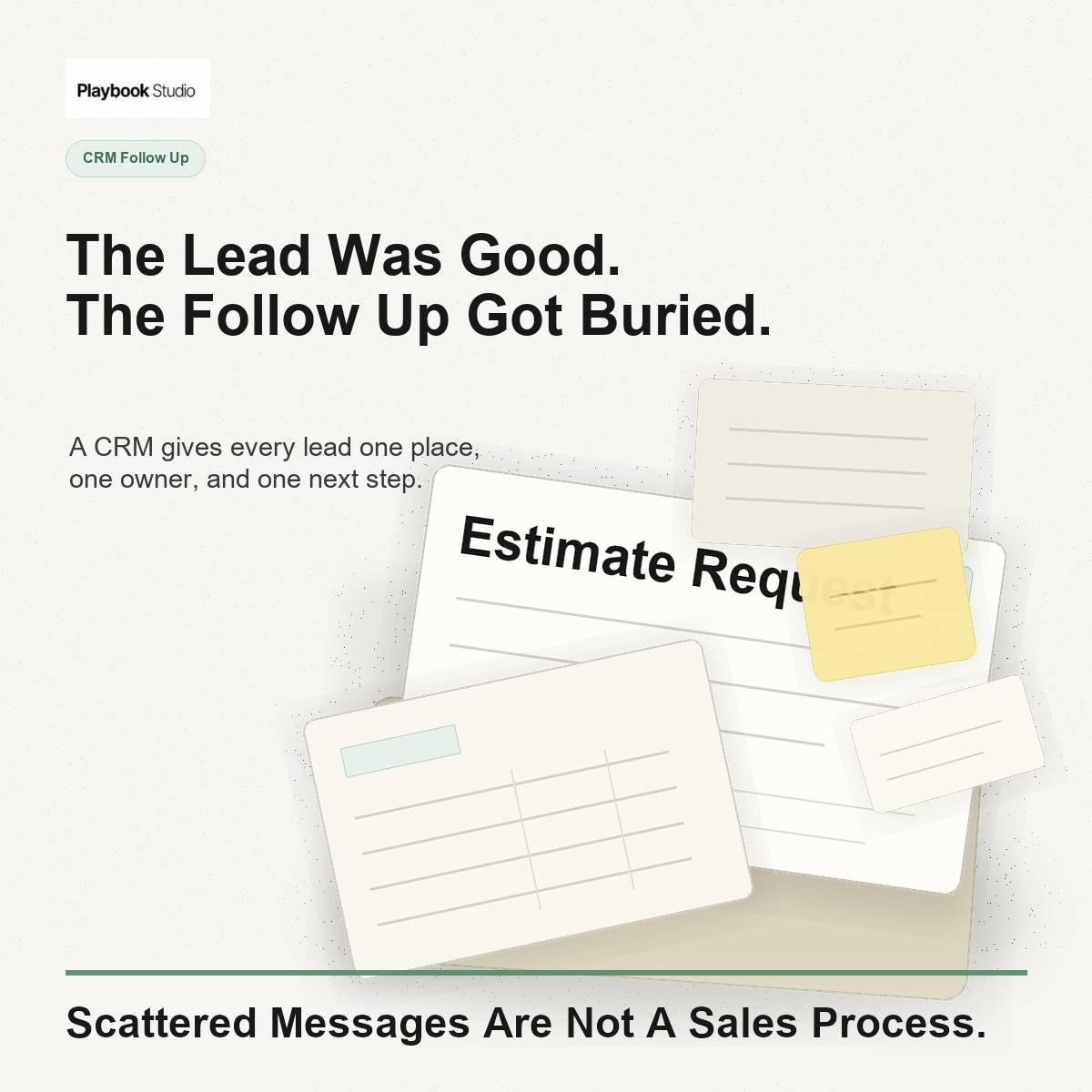
A customer calls while you're on a job.
A form comes in after hours.
Someone texts your personal phone asking for an estimate.
A quote goes out, but nobody follows up.
A past customer says, "Reach back out next month," and then next month comes and goes.
That's how business leaks out of a local company.
It doesn't always look like a marketing problem at first. It looks like missed calls, forgotten estimates, scattered notes, old texts, full inboxes, and customers who seemed interested but never booked.
You may think you need more leads.
Sometimes you do.
But if your leads are already coming in and nobody can clearly see who needs a reply, who needs a follow-up, and what happened last time, more leads won't fix the real problem.
You need a better place to keep track of the business you already have.
That's where a CRM comes in.
The problem isn't "no CRM." The problem is lost follow-up.
A CRM stands for customer relationship management.
That sounds more complicated than it needs to.
For a local business, a CRM is simply the place where leads, customers, jobs, estimates, notes, and follow-ups stop disappearing.
The real issue isn't that you don't have fancy software.
The real issue is that a customer can show interest and still slip through the cracks.
That happens when lead information is spread across:
- phone calls
- text messages
- email inboxes
- website forms
- Facebook messages
- spreadsheets
- notebooks
- memory
- different employees' phones
One person may know the customer called.
Another person may know the estimate was sent.
Someone else may remember that the customer wanted to wait two weeks.
But if there's no shared place where that information lives, the business is depending on memory instead of a system.
Memory isn't a follow-up process.
It works until the day gets busy, the phone rings twice, someone is out sick, a job runs long, or the owner is pulled into something else.
Then a good lead becomes an old message.
A CRM is where customers stop disappearing
You don't need to turn your business into a software company.
You need one reliable place where every lead and customer has a record.
A useful CRM keeps track of things like:
- who the customer is
- how they found you
- what they asked for
- what service they need
- when they contacted you
- who replied
- whether an estimate was sent
- what the next step is
- when to follow up
- what happened last time
That's the basic job.
ServiceTitan, Jobber, Housecall Pro, HubSpot, and GoHighLevel all solve some version of this problem.
Some are built more for home service companies. Some are broader sales and marketing platforms. Some include scheduling, estimates, payments, automations, and reporting.
The point of this article isn't that every local business needs the same platform.
A plumber using ServiceTitan may need something different from a small shop using HubSpot or a service business running follow-up through GoHighLevel.
The tool matters.
But the habit matters more.
Every lead goes into one place.
Every customer has a history.
Every open opportunity has a next step.
If your current setup doesn't do that, you're probably losing business you already worked to earn.
Signs you're already losing business without one
You don't need a consultant to tell you whether your follow-up is messy.
You can usually feel it.
Here are the signs.
You can't quickly see every open estimate
If you have to search emails, texts, notebooks, and memory to figure out which estimates are still open, follow-up is going to be inconsistent.
Some customers will get a reminder.
Some won't.
Some will call a competitor because they were ready to move and nobody checked back in.
You don't know which leads still need a reply
A lead shouldn't depend on whether someone remembered to tell you about it.
If calls, forms, and messages come in from different places, you need a way to see what's new, what has been answered, and what still needs attention.
Otherwise, response time becomes luck.
You rely on memory to follow up
Memory feels fine when volume is low.
Then business gets busy.
Now the same owner who remembered every customer detail is also handling jobs, employees, vendors, calls, invoices, and problems.
That's when good intentions turn into missed follow-ups.
Customers have to repeat details they already gave you
This is one of the fastest ways to make a business feel disorganized.
A customer explains the issue once.
Then they explain it again to another person.
Then the estimator shows up without the full context.
Even if the work is good, the experience feels sloppy.
A CRM helps the business remember for the customer.
Old customers only hear from you when they call first
Past customers are often the easiest people to sell to again.
They already know you.
They already trusted you once.
But if they aren’t stored anywhere useful, they disappear until they need something badly enough to call.
That leaves repeat work, referrals, reminders, and seasonal follow-ups sitting unused.
You don't know which marketing sources produce real jobs
This is where the CRM connects directly to marketing.
It isn't enough to know where leads came from.
You need to know which sources produced customers, booked jobs, good-fit estimates, and repeat work.
Without that connection, you may keep paying for marketing that creates noise while underinvesting in the channels that actually bring in good business.
The CRM doesn't have to be complicated
A lot of local business owners avoid CRM systems because they picture a giant software rollout.
Dashboards.
Automations.
Pipelines.
Tags.
Custom fields.
Training.
A system nobody uses after two weeks.
That's a fair concern.
Bad CRM setups create busywork.
They ask for too much information, slow the team down, and become another thing everyone avoids.
But the answer isn't to avoid having a system.
The answer is to start with the simplest version that solves the real problem.
For many local businesses, the first version only needs to make sure:
- every lead is captured
- every customer is saved
- every estimate is tracked
- every next step is assigned
- every follow-up is visible
- every lead source is recorded
That's enough to create a major improvement.
You can add automation later.
You can add reporting later.
You can add more detailed stages later.
But if the first version doesn't make follow-up clearer, it isn’t the right first version.
What the right CRM setup should actually do
A good CRM setup should answer practical questions quickly.
Not someday.
Not after exporting a spreadsheet.
Quickly.
Questions like:
- Who needs a call back today?
- Which estimates are still open?
- Which leads haven't been contacted?
- Which customers are due for follow-up?
- Where did this lead come from?
- What happened last time we talked?
- Who owns the next step?
- Which jobs came from which marketing source?
If your system can't answer those questions, it isn’t doing the job yet.
That doesn't mean the software is bad.
Sometimes the problem is the setup.
Sometimes the stages are unclear.
Sometimes leads aren't being entered consistently.
Sometimes the team doesn't know who owns follow-up.
Sometimes the CRM is being used as a contact list instead of a sales and service process.
The goal isn't to have more data.
The goal is to make the next action obvious.
A lead came in.
Who's responding?
An estimate was sent.
When is the follow-up?
A customer booked.
Where did they come from?
A past customer is due for service.
Who's reaching out?
That's what the system should make easier.
The real win is control
The real value of a CRM isn't the software.
It's control.
Control over lead response.
Control over follow-up.
Control over customer history.
Control over repeat business.
Control over which marketing sources are producing actual revenue.
Without a CRM, the business is often controlled by whatever is loudest that day.
The newest call.
The latest text.
The customer who follows up first.
The employee who happens to remember.
That's a stressful way to run a company.
It also makes growth harder.
More leads create more moving parts.
More employees create more handoffs.
More marketing creates more sources to track.
More customers create more follow-up opportunities.
If the system is already messy, growth doesn't always make the business better.
Sometimes it just makes the mess bigger.
A CRM gives the business a place to put that complexity before it turns into missed work.
Do this quick CRM audit
Before you shop for software or rebuild your entire process, run a simple check.
Pick five leads from the last two weeks.
For each one, ask:
- Where did this lead come from?
- Did they get a response?
- Who responded?
- What did they need?
- Was an estimate sent?
- Did they book, decline, disappear, or need another follow-up?
- Who owns the next step?
- Can you find the full history in under 60 seconds?
If you can't answer those questions clearly, you don't just have a software gap.
You've a visibility gap.
That gap costs real business.
It costs missed calls.
It costs forgotten estimates.
It costs repeat customers who never hear from you again.
It costs marketing dollars because you can't clearly see which leads turn into work.
The fix doesn't have to be complicated.
But it does need to be intentional.
Your business needs one place where leads go, one process for what happens next, and one clear way to see what still needs attention.
That's what a CRM should help you build.
If your leads are scattered across calls, texts, forms, spreadsheets, and memory, Playbook Studio can help you map the simple CRM setup your business actually needs before you buy, rebuild, or overcomplicate anything.
Not sure what CRM setup your business actually needs?
If your leads are scattered across calls, texts, forms, spreadsheets, and memory, Playbook Studio can help you map the simple CRM setup your business needs before you buy, rebuild, or overcomplicate anything.
More local business website fixes
- How Can You Turn More Estimates Into Customers?
- How to Build a Referral System That Generates Leads
- Build Contact Forms That Help You Find the Right Jobs Faster
- Calls to Action Are Weak
- You Sound Like Everyone Else
- Website Traffic but No Leads?
- Does Your Website Build Enough Trust?
- Why Your Website Is Not Building Trust
- Site Does Not Explain Services Clearly
- How to Tell What Marketing Is Working
- How Fast Should You Follow Up With Leads?
- Why Don't Leads Turn Into Bookings?
- Should You List Service Pricing?
- Why Your Google Business Profile Gets No Calls
- Your Website Should Tell Us Where You Work
- Tired of Buying Junk Leads?